A New Concept for the Future of Housing Comes to La Feria del Diseño 2026
From September 10 to 12, Medellín hosted a new edition of La Feria del Diseño, one of Latin America’s leading gatherings for architecture, design, and the creative industries. As part of the event, Gómez Platero presented Expanded Living, a new concept that proposes rethinking the future of housing through well-being, human connection, and the relationship between domestic space, public space, and the city.
Reading time: 3 minutes
Now in its thirteenth edition, La Feria del Diseño Medellín powered by idd cologne brought together 285 exhibiting brands from eight countries — Colombia, Italy, Spain, Turkey, the United States, Belgium, Brazil, and Peru — at Plaza Mayor, reinforcing its role as a platform connecting the design, architecture, and built-environment industries across Latin America.
The exhibition was distributed across Plaza Mayor’s Blue, Yellow, White, and Green pavilions, featuring solutions for residential and contract furniture, kitchens, architecture and interior design, lighting and technology, well-being, and outdoor spaces. The offering brought together Colombian companies and international brands that came to Medellín to gain a deeper understanding of the market, connect with specifiers, and explore new opportunities across the region.
Participating brands included IKEA, Porcelanosa, Diemme, LAMP, Wever & Ducré, Technogym, Higold, Zientte, MUMA, Herman Miller, and Hunter Douglas. The event’s business dimension also played a central role, with its Business Roundtable projecting nearly 780 meetings between companies, buyers, and industry professionals.
With close to 19,000 visitors projected to attend at Plaza Mayor, the program combined the trade exhibition with conferences, professional gatherings, and activities across different locations in Medellín. Rather than focusing solely on exhibition, La Feria once again positioned itself as an ecosystem connecting knowledge, industry, and new opportunities for collaboration.
__________________________________________________________________________________________________
Explore the topics that have shaped the sector’s recent agenda:
Discover other GP participations at La Feria del Diseño
__________________________________________________________________________________________________
Expanded Living: a conversation about new ways of inhabiting
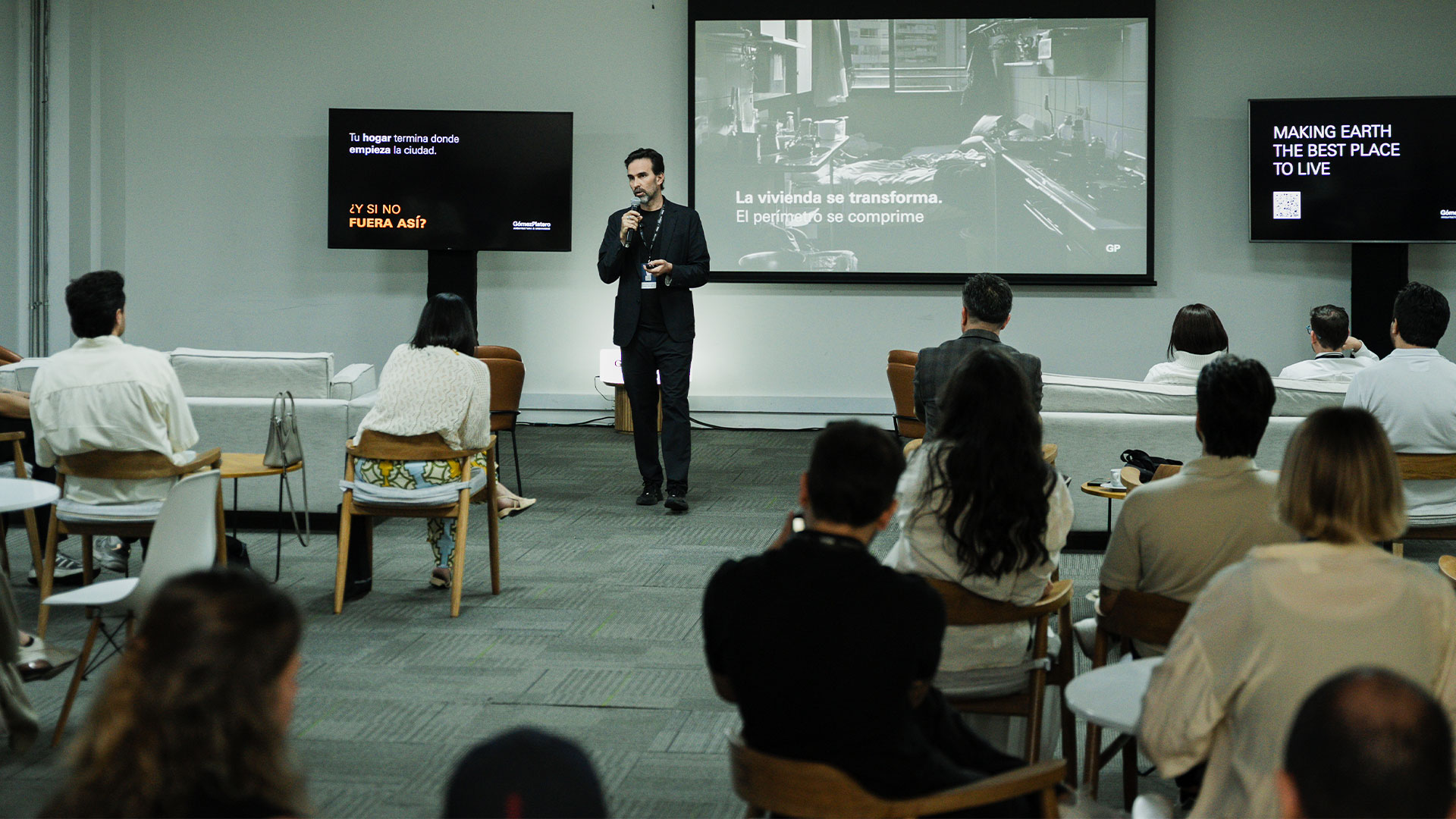
Within this context, Gómez Platero presented "Expanded Living" on September 11 during a brunch that brought together guests and leading professionals from architecture, design, and Real Estate.
The presentation was led by Juan Ciapessoni, GP Advisor for Innovation and Business Development, who introduced the main ideas behind an exploration that begins with a question: how far can our experience of inhabiting extend?
"Expanded Living" proposes looking at housing beyond its physical boundaries and understanding it as part of an experience that also encompasses shared spaces, public space, and the city. In response to increasingly individualized ways of living, the concept explores how architecture can create conditions that encourage movement, encounters, and connections between people.
Rather than attempting to program these relationships, the proposal seeks to multiply the opportunities for them to emerge, incorporating movement, proximity, and collective spaces into an everyday experience of inhabiting that connects the individual with the collective.
Gómez Platero’s delegation in Medellín also included Ricardo Fernández, Business Development Manager for the Americas, and Victoria Posada, Head of Marketing & Communications, who joined the presentation and participated in the different opportunities for exchange generated throughout La Feria.
The gathering provided an opportunity to share the new concept with professionals and industry leaders and to open a conversation about how architecture can respond to new ways of living and contribute to housing experiences in which well-being depends not only on private space, but also on our ability to meet, move, and connect with others.
Explore new ways of living that connect housing, public space, and the city.
Download the event summary: