The simplest stroke, the deepest intention
At the threshold of every new year, we have the chance to condense, in a single gesture, a stance on architecture and the city. The close of 2025 revolves around the most elemental graphic unit: a stroke that inscribes a human figure in space and poses the question that precedes every architectural and urban project: Who will inhabit this space?
Every project begins before it is materialized in any medium. It starts in that first encounter with our clients: when we listen to and give form to their desires, recognize their needs, read the physical, cultural, and environmental context, and almost simultaneously begin to imagine a possible life in the setting of the future project. The person who commissions the work is a constitutive part of that initial architectural gesture: they are the starting point of any design operation. Without a client there is no proposal and, when that figure is not clearly defined, it becomes necessary to imagine it and give it a voice in order to design with meaning.
Our year-end greeting returns to that first gesture—that instant when a conversation becomes a project—and takes it as the conceptual core of our closing message for the cycle.
This piece distills a conviction: the simplest gesture can carry the deepest intent when it is guided by a question about the future. Not a future in the abstract, but one that is shaped in the present, every time we decide how a space is inhabited, which relationships are enabled, and which landscapes are cared for.
The physical object that emerges from this reflection—our year-end card, conceived as the closing moment of the 2025 cycle—is an invitation to read each intervention in the territory as a response, always provisional, to a simple question that places people at the center of the creative process: Who will inhabit this space?
Scale, Body, and Habitable Space
In architectural drawing, scale often appears as a human figure that helps us grasp the dimensions of space. From this perspective, scale is not just a measurement; it is also a gesture that situates the body—the subject—at the center of the project.
That body is not generic: it gathers many different ways of inhabiting space. Following this logic, architecture ceases to be something isolated and becomes the framework within which everything happens—a place that only acquires meaning when someone lives there.
Seen this way, every space we draw entails a responsibility toward the everyday experience that will unfold there. Scale does more than measure; it also recognizes, includes, and invites.
Drawing Presence
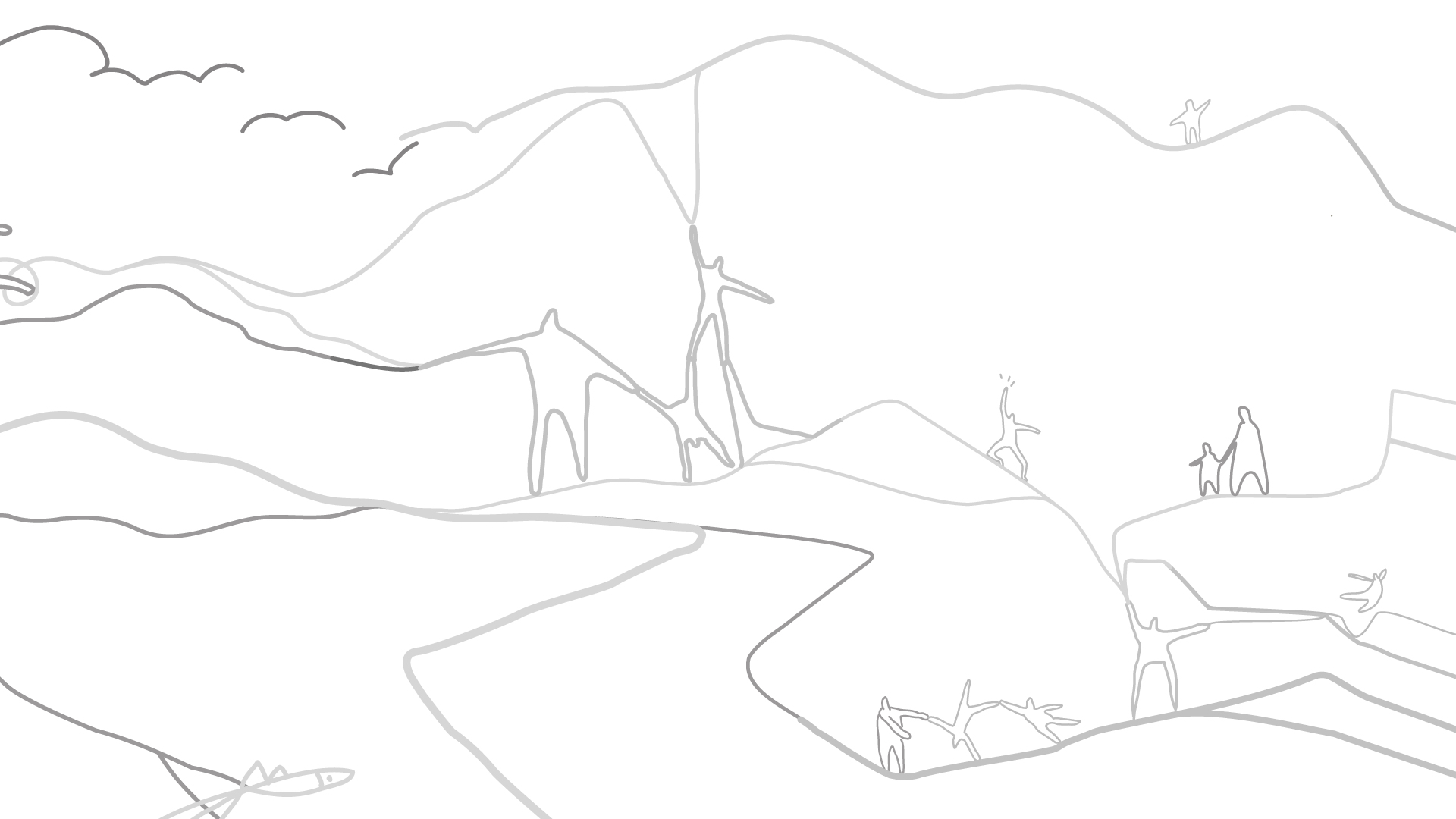
The chosen graphic gesture is deliberately minimal: a series of schematic, hand-drawn human figures that unfold across sections, plans, or barely suggested landscapes.
In their apparent simplicity, these presences embody the subject of inhabitation and act as a critical device: to draw—even with just a few strokes—is to anticipate presence. It is to acknowledge that, even before the building exists, someone will already be there to inhabit it. Each figure introduces a possible story into the scene: a path, a pause, a conversation, a shared gaze. In this way, space ceases to be an abstract void and becomes a potential place, charged with relationships.
This device also alludes to the collective nature of design. The variety of strokes, postures, and gestures suggests different ways of inhabiting, different biographies and sensibilities projected onto the page. Architecture thus appears as the result of a shared effort between those who conceive the space and those who sustain it with their everyday lives, in a dialogue that goes far beyond mere formal definition.
In this context, drawing becomes a way of beginning: the first assertion that something will happen there between bodies, matter, and landscape.
Grounded in an elemental stroke and in the persistence of a single question, the close of this cycle and the beginning of a new one in 2026 offer a clear synthesis: architecture finds its fullest meaning when it lets go of the idea of thinking itself in isolation and instead understands itself as a stage for life. A single graphic gesture is enough to remind us of this: inscribing a human figure in space is, at once, imagining a habitable world and assuming the responsibility of making it possible.

Let’s make this year a shared project.
Happy 2026!