Big data has become a central resource for architecture and cities. Yet when information lacks structure, it turns into data smog that clouds decision-making. Giving data an architecture of its own is essential if human judgment and spatial intelligence are to keep guiding the design process.
Reading time: 5 minutes
Never have architects and urban planners had so much information about cities and buildings. Mobility traces, environmental sensors, smart meters, occupancy records, social media geolocation, and detailed BIM models feed a constant flow of data that, in theory, should make it possible to develop more precise, efficient, and responsive projects.
However, when that information is collected without a clear purpose, hierarchy, or interpretive framework, it stops guiding decisions and becomes data smog: an overload that overwhelms our ability to filter, prioritize, and act.
In practice, project teams accumulate surveys, energy simulations, digital dashboards, usage analytics, and benchmarking studies; each stakeholder brings their own datasets and their own platform. Instead of sharpening the project, this layering tends to blur it: intentions become diffuse, and essential spatial questions—where to open, where to close, how to organize life over time—are pushed aside by an ever-expanding list of metrics.
The problem is not the data itself, but the absence of an underlying structure: without architecture, information dissolves into noise.
The Architecture of Data

Just as a building requires structure, circulation, and programmatic clarity, information needs an arrangement that allows it to support design instead of overwhelming it.
This architecture of data can be summarized in three operations:
- Positioning the questions
The starting point is not “What data do we have?” but “What do we need to understand to make better decisions in this project?”
- Selecting and grouping information
Once the questions are defined, only a subset of the available data is truly relevant. That information can be organized into coherent families—environmental performance, usage patterns, accessibility, cost, social impact—instead of being treated as hundreds of isolated indicators. This reduces noise and makes it easier to identify relationships between variables, much like how rooms are articulated around a clear circulation spine.
- Translating data into criteria
Data becomes operative when it is translated into explicit design criteria and thresholds. These criteria do not emerge automatically from the numbers; they require negotiation, judgment, and value-based decisions.
With this architecture in place, data ceases to be an inert mass of information and becomes a framework—a skeleton of evidence on which spatial imagination can operate.
The potential of data becomes especially visible when it is framed by clear questions and criteria: it stops being a generic input and becomes a tool that guides concrete decisions.
At the urban scale, mobility and location records reveal how streets, parks, and transport systems are actually used. Analysis of pedestrian and cycling flows helps decide where to widen sidewalks, add bike lanes, or locate new public spaces where informal encounters already occur, reinforcing pre-existing social energies. Digital twins integrate geospatial, environmental, and infrastructural layers to simulate how new buildings will affect wind, shade, or traffic before they are built, providing an objective basis for shaping volumes and voids.
At the building scale, networks of sensors and smart meters track temperature, CO₂, occupancy, and energy use, while real-time digital twins make it possible to monitor performance and anticipate adjustments. In an office, for example, correlating comfort data with user feedback can reveal critical time bands and orientations, guiding targeted decisions about shading devices, glazing configurations, or ventilation strategies.
In all cases, more than accumulating information, what really matters is formulating a small set of essential questions—what kind of use is intended, for whom, under what conditions—and selecting only the data that helps answer them, so the project gains precision without losing clarity.
Retail as Precursor

Long before the discourse on “smart buildings” became widespread, retail environments were already functioning as data-intensive laboratories. Supermarkets, shopping malls, and fashion chains have spent decades experimenting with an architecture of data, using information to shape layouts, circulation patterns, and atmospheres.
What makes retail distinctive is not just the volume of data, but the clarity of its questions. A typical store dashboard is organized around a few key metrics: footfall, dwell time, conversion rate, and average ticket value. This already defines a basic architecture of data: a compact set of indicators directly linked to spatial decisions.
Some concrete dynamics illustrate this:
• Heat maps and shelf layouts
Many supermarkets track how customers move through the store and how long they linger in front of each shelf. Heat maps reveal “cold” areas with low activity and “hot” corridors where flows are intense. This information shapes the floor plan: higher-margin products move into areas of high visibility, circulation loops are adjusted to encourage encounters with certain categories, and aisle widths are tuned to the desired pace of movement. The plan drawing is, to a large extent, a response to questions posed by the data.
• Anchor tenants and circulation in shopping malls
In shopping malls, footfall analytics show how often visitors reach certain points, how long they stay, and which sequence of stores they follow. Drawing on this prior analysis, anchor tenants—such as supermarkets, cinemas, and department stores—are placed in strategic locations to pull flows through the building. Transition spaces, escalators, and voids are calibrated to sustain this movement. The resulting spatial figure emerges, in part, from behavioral patterns: the architecture of the mall is also an architecture of data.
• Checkout-free convenience stores
In checkout-free store formats, every movement of the shopper and every product taken from a shelf is recorded by cameras and sensors. The building becomes a large-scale sensing device. Decisions about layout—the number of aisles, their height, the overlap between categories—are validated or adjusted in response to thousands of micro-interactions. The store is continuously “redrawn” by an ongoing flow of information.
What positions retail as a precursor is not only its technical capacity to collect data, but the discipline with which it structures it. The sector has learned to resist the temptation of infinite metrics and instead to maintain a compact set of questions that link data to action: Do people come in? Do they find what they are looking for? Do they stay long enough? Do they buy?
That discipline offers at least two lessons for architecture more broadly:
• Linking data to a limited number of decisive questions
Just as a store does not need dozens of indicators to decide where to place its entrance, a cultural building does not require an endless list of variables to determine where to open its main foyer. The key is to identify the few metrics that are directly related to the desired experience and performance.
• Ensuring that spatial change remains possible and legible
In retail, the modularity of shelving, demountable partitions, and flexible lighting enables layouts to be adapted in response to new evidence. In other building types—offices, hospitals, campuses—the equivalent would be a tectonic language that allows reconfiguration without erasing the identity of the place. In this way, data can inform a living architecture rather than a one-off, rigid optimization.
At the same time, the example of retail reminds us that a strictly performance-driven logic can push other values to the margins: comfort, working conditions, local character, and so on. As similar tools migrate into housing, public space, and workplaces, the question becomes sharper: Which metrics are being optimized, and who decides what matters?
Learning from retail means adopting its clarity in structuring information while avoiding its more reductive tendencies. The aim should be to use data with the same operational intelligence, but in the service of more diverse and more equitable ways of life.
People-Led Architecture, Informed by Data

Even with a carefully designed architecture of data, numbers remain partial. They describe frequencies, correlations, and performance, but they do not carry meaning on their own. They cannot, by themselves, answer questions such as: Does this space dignify its users? Does it contribute to a more resilient city? Is this building capable of hosting future ways of living and working?
To address these questions, architecture must remain fundamentally people-led. Common sense, bodily experience, conversations with users, professional intuition, and sensitivity to context are irreplaceable. They function as the primary structure within which data is interpreted, analogous to a load-bearing skeleton that supports and organizes a complex envelope.
This has several implications:
• Resisting reductionism
Not everything that matters can be measured, and not everything that can be measured is relevant. Recognizing this prevents projects from being governed solely by the optimization of metrics such as rentable area, footfall, or kilowatt-hours, at the expense of social and cultural dimensions.
• Questioning data biases
Many datasets are incomplete or biased. Mobility apps over-represent certain groups; energy models rely on standardized user profiles that rarely match local habits; historical data often reflects existing inequalities. Without critical interpretation, data risks reinforcing asymmetries instead of correcting them.
• Protecting privacy and agency
In “smart” buildings and cities, data on movement, preferences, and routines is collected continuously. Ethical questions around consent, anonymity, and ownership of that information cannot be delegated entirely to technology providers; they are also design questions, because they affect how people relate to spaces and to one another.
Ultimately, the goal is not to build data-driven architecture in the sense of spaces that mechanically follow the logic of metrics, but people-led architecture informed by data: projects in which information is rigorously structured and subordinated to a clear spatial and social intent.
In that scenario, big data becomes what it should always have been: a valuable ally. It helps reveal invisible patterns, test assumptions, and adapt buildings over time. But it does not replace the responsibility of deciding what kind of city, and what kinds of lives, architecture should make possible. That responsibility remains—and must remain—fundamentally human.
From Smart Cities to Sensitive Cities
The current debate around “smart cities” shows clearly how data-driven logics can drift away from this human core. Over the past decade, many urban agendas have been structured around sensor networks, algorithms, and automated systems designed to optimize traffic, energy, and services. Cities are increasingly described as platforms that can be monitored and managed in real time.
This vision has yielded significant efficiency gains, but it also carries a risk: reducing the city to a technical system instead of understanding it as a lived, emotional, atmospheric environment. A street where light, noise, and flows are perfectly regulated can still feel sterile; a square under constant monitoring may discourage informal uses and spontaneous encounters. A city can be “smart” in data terms and still be insensitive to the everyday experience of its inhabitants.
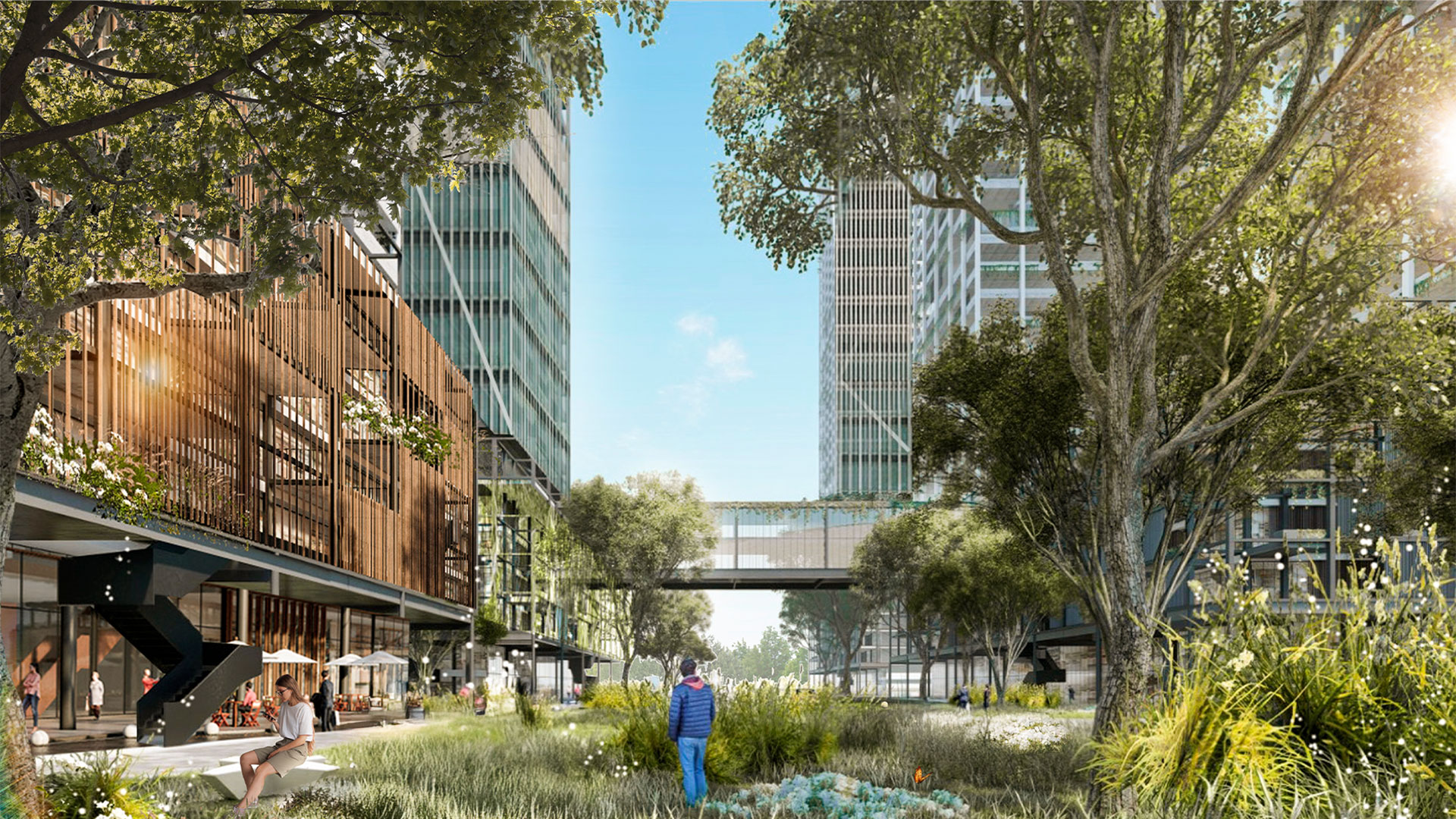
In response, various authors and urban design practices have begun to speak of sensitive cities as an alternative horizon. Rather than focusing exclusively on calculation, this perspective emphasizes perception: the capacity of urban spaces to register climate, moods, and ecological rhythms, and to respond with care instead of pure optimization. A sensitive city does not measure only flows and consumption; it also attends to gradients of light and shade, the distribution of heat and pollution, the presence of non-human species, and the emotional texture of public life.
From this vantage point, the issue is not abandoning data but reorienting it. Environmental sensors, pollution monitors, and biodiversity counts can become tools for designing more attentive microclimates: pavements that absorb water and reduce heat, acoustic canopies that filter sound, vegetation that shelters insects and birds while providing shade. The metric shifts from pure efficiency to care: to what extent spaces sustain coexistence between species, protect the most vulnerable groups under extreme conditions, and enable a broader range of sensory experiences.
Reintroducing these ideas into architectural practice raises a simple but demanding question: Do our data strategies amplify perception or intensify control? A human architecture, informed by data, uses information not only to fine-tune systems but to cultivate this expanded sensitivity. In this sense, the shift from smart cities to sensitive cities does not mean rejecting technology; it means reordering priorities. Data remains present, but it is placed at the service of empathy, atmosphere, and ecological awareness. The ultimate indicator of success is no longer how much we can measure, but how deeply we are able to listen.